Introduction
NIKA is an open-source static code analyzer that is capable of performing a cross-file taint analysis to identify security vulnerabilities.
Who is this for?
- Product Security teams looking to automate security scanning for microservices.
- Security Engineers performing gray-box and white-box security assessments.
Skip the Docs, Get Running Fast
If you want to quickly get started with Nika, follow the Installation Guide.
Language Support Matrix
| Language | Current Support |
|---|---|
| Java | ✅ Fully Supported |
| Python | 🚧 Planned |
| C/C++ | 🚧 Planned |
Tool Workflow
-
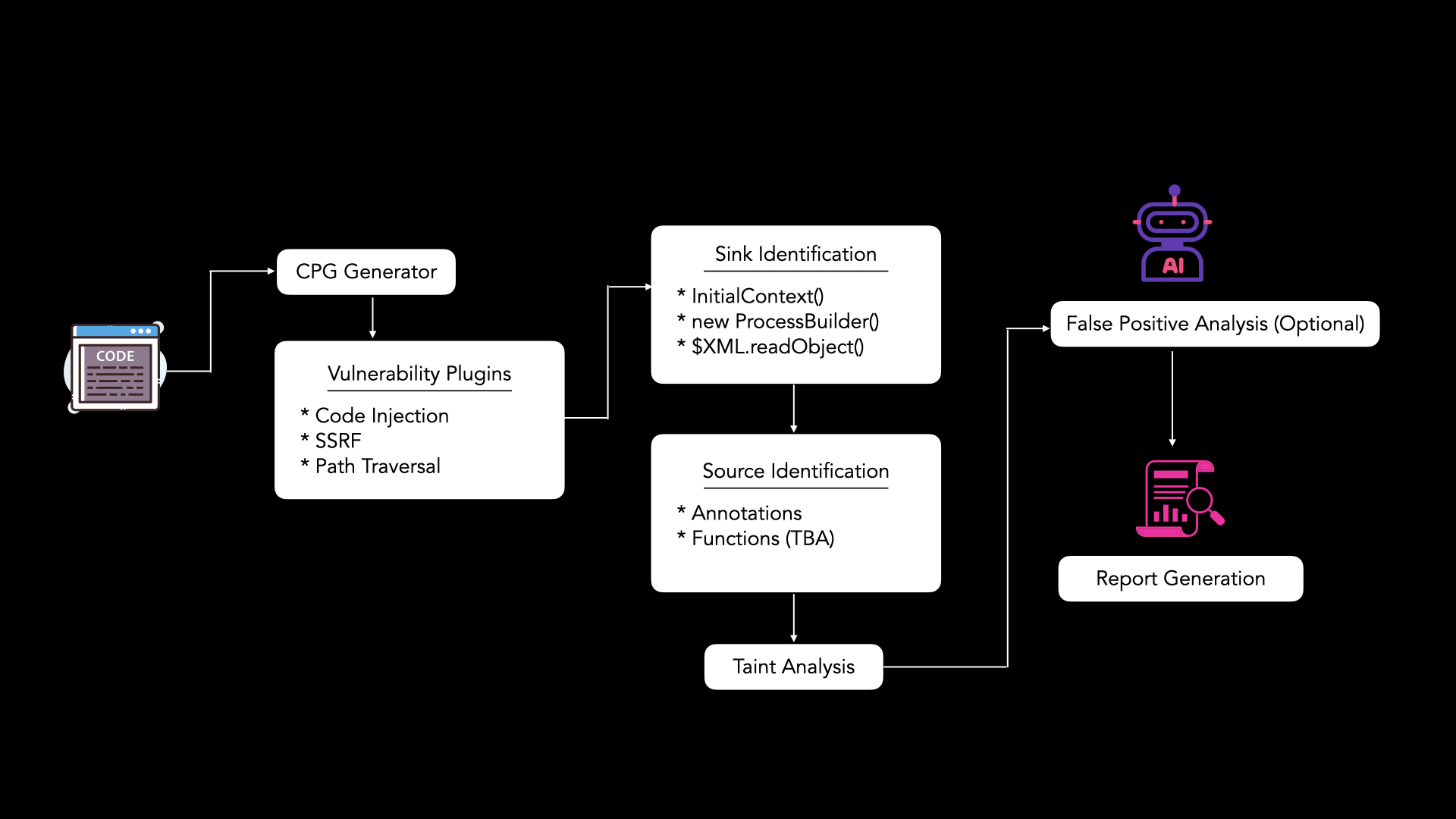
The source code repository is first processed to generate a Code Property Graph (CPG), which provides a unified representation of the code structure, control flow, and data flow for analysis.
-
Vulnerability-specific plugins define the required sources, sinks, and propagation patterns for different vulnerability classes such as SSRF, Code Injection, and Path Traversal.
-
The engine identifies dangerous sink functions such as command execution, XML deserialization, database queries, and outbound network calls.
-
The framework identifies attack-controlled input sources such as API annotations, request parameters, headers, and other externally influenced inputs.
-
Using taint analysis, the system traces whether untrusted input can flow from identified sources to security-sensitive sinks across files and functions.
-
The taint engine performs cross-file and inter-procedural analysis to identify realistic exploit paths rather than isolated code patterns.
-
Detected findings are passed through an AI-assisted false positive analysis layer to improve accuracy and reduce noisy results.
-
The final stage generates a structured vulnerability report containing the vulnerable flow, source-to-sink path, affected files/functions, and remediation guidance.
What vulnerabilities does it cover ?
| Issue | Description |
|---|---|
command_injection |
Flags OS command execution sinks such as Runtime.exec(...) and ProcessBuilder.start() when attacker-controlled input can influence commands or arguments. |
code_injection |
Flags dynamic expression/code evaluation sinks such as ScriptEngine.eval(...), OGNL, Java EL, and MVEL.executeExpression(...) when expressions are built from untrusted input. |
order_scan |
Flags security-critical call-order violations in sensitive execution flows and validation chains. |
sqli |
Flags SQL/HQL query construction using string concatenation or dynamic builders that reach execution sinks across JDBC, Spring, Hibernate, JPA, jOOQ, and related frameworks. |
path_traversal |
Flags user-controlled filesystem path construction and file access sinks such as File, Paths.get(...), FileInputStream, and related APIs. |
ssrf |
Flags outbound request and URL construction sinks across Java core libraries and HTTP clients including HttpURLConnection, RestTemplate, WebClient, OkHttp, Apache HttpClient, and others. |
template_injection |
Flags Server-Side Template Injection (SSTI) sinks where templates are dynamically compiled or evaluated from untrusted input. |
deserialization |
Flags unsafe object deserialization and polymorphic object materialization sinks such as ObjectInputStream.readObject, XMLDecoder.readObject, Jackson polymorphic typing, JNDI lookups, and related APIs. |
cryptographic_failure |
Flags weak or insecure cryptographic primitives, cipher modes, insecure randomness, JWT verification weaknesses, and static IV/key reuse patterns. |
unsafe_reflection |
Flags reflective class loading using attacker-controlled or non-literal class names through APIs such as Class.forName(...). |
xxe |
Flags XML parsing and transformation sinks that may allow external entity resolution across DOM, SAX, JAXB, XPath, XStream, and related XML processing libraries. |